
Train Dreams
Thoughts on AI’s impact on money -- and a belated eulogy for an American legend

In this edition:
What happens when friction disappears?
Could AI make our worst financial habits worse?
What if David Foster Wallace and Warren Buffett went on a cruise?
A prominent computer scientist described artificial intelligence as “feeling like a runaway train that we’re chasing on foot.”
It’s a good metaphor — not only for the pace at which AI seems to be advancing, but also for how the discussion around it feels, like a fever dream. It’s coming for our jobs, so we better learn to work smarter, or change our jobs, or stop worrying about whether we need work, or save every cent we have, or stop worrying about having to save for the future at all. What’s less talked about are the good things we might leave behind and the bad things we might carry with us.
Trains are unlikely what you picture when thinking about the United States. Yet America has by far the largest railway network in the world. Well, most of it is for freight, which is its own good metaphor — all these train cars crossing the country transporting stuff to people, not people to stuff. If only gifted eyes and souls, carriages of coal, lumber and boxed goods would get to marvel at sweeping views of spacious skies, amber waves of grain and purple mountain majesties.
For me, trains bring to mind thoughts about pennies. Because I imagine a railway in particular that stretches across the northern part of the country through the belly of Michigan’s Upper Peninsula. At one point, it reaches the town of Engadine and passes a lumber mill and high school football field.
Across the road sits a single-story home, where once upon a time it was not uncommon to find a group of kids whiling away long summer days. This is my grandmother’s house. One thing I remember me and my cousins did was place pennies on the tracks and patiently wait for the unmistakable sound of a huffing freight train. When the train came, we scrambled out to the front yard to shout and wave at the conductor, then sprinted to find the remains of our coins. The pennies were compressed into thin, oval-shaped, bronze-colored wafers, the visage of Abraham Lincoln now erased under tons of tumbling steel.
It’s an experience fewer future kids on lazy summer days will have — and not only because they are too glued to a screen to notice the thunder of passing trains. The American penny is no more. Born in 1793, dead in 2025.

It was a good run. How many days were made upon finding a penny in the crevices of a couch to make exact change for something? Or, how many lives made upon being cast into a fountain and granting a wish for healing or love or luck?
But it makes perfect sense, as it costs more to produce than it’s worth. Heck, the fact we ruined them for fun is a testament to their monetary value.
As someone who often doesn’t carry cash, I’m not mourning the penny itself. But I can’t help but feel sentimental, as it’s happening at a time when history seems to be at an inflection point. In a way, the death of the penny is as another symbol of the cultural push to eliminate friction and inconvenience, to maximize having and minimize doing, to become faster and instantaneous.
I don’t know where this train is going, but I’m suspicious of the idea fast and easy is always better when it comes to money or life.
As Gandhi once proclaimed:
“There is more to life than increasing its speed.”
Instant gratification isn’t gratifying
In the book, Freedom, the fromer war correspondent and author Sebastian Junger recounts his journey walking 400 miles along railway lines from Washington, D.C., to Pittsburgh, evading police and railroad company employees along the way.
As a meditation on what it means “to be free,” Junger writes:
“For most of human history, freedom had to be at least suffered for, if not died for, and that raised its value to something almost sacred.”
I don’t think financial freedom is worth dying for, but relatedly, one research paper shows that money earned through labor is more important to people than money that comes from other sources (such as investments or a winning lottery ticket). The struggle raised its value.
When we have to make a hard decision or act against our innate desires, we value money more. That is the meaning of Ben Franklin’s famous quip:
“A penny saved is a penny earned.”
Further, how we interact with money can shape how we behave with it. Researchers found that as cash fades from our wallets, so too does our awareness of spending, leading to impulsive and unnecessary purchases. The result is a greater tendency to give in to temptation, to satisfy the urge for instant gratification.
Dr. Jashim Khan, lead author of the study, put it this way:
“The visceral nature of cash—its smell, feel and the act of counting it—creates an emotional connection that digital payments lack. When we handle cash, we are not just spending money; we are parting with a piece of ourselves.”
So what happens when that “freedom” no longer costs anything, when barriers to instant gratification are coded out of existence?
You might argue that with a few taps on his phone, a 20-year-old man began writing his suicide note after mistakenly believing he had incurred a massive, unrepayable debt of over $730,000 through his Robinhood trading account in 2020.
It’s an exceptional case, sure. But the ubiquity of the internet arguably entices people to think less and exacerbates troubling behavior, as people trade the harship of real life for the accessibility and instant gratification found online.
For instance, gambling has transformed from an activity that required living in the right place with the right laws in proximity to a casino into an app in your pocket, leading to an increase in bankruptcies and debt.
The legendary music producer Rick Rubin wrote:
“Our continual quest for efficiency discourages looking too deeply.”
That to me is the biggest disruption from the advancement of AI. It’s easier to surrender to temptation when there is less to think about. We can do whatever we want whenever we want with our money that we fail to stop and consider whether we should.
The penny was retired because it was too costly to produce. And the promise of AI and all corollary technology is to eliminate anything from our lives deemed too costly to produce. In some ways that’s good, but not in every way.
You see the latter now with content. The writer Dorothy Parker famously said, “I hate writing, I love having written.” AI is marketed as the solution. Writing production cost hits zero, but now supply is practically infinite.
Like money, when creation becomes instantaneous nothing feels earned, and therefore nothing feels worth longing for. A world where you can make anything at any time can easily become a world where nothing feels necessary.
It’s anathema to all the things we associate with aspirations like excellence, building wealth, creating a happy life — discipline, long-term thinking, hard work.
In some respects, the use of AI feels like a debt. It’s a temptation. Use it once and it becomes more comfortable to use it again and again, until you’re not doing much of the creating nor much of thinking. Suddenly, that wall you had to resist temptation is a pile of rubble, knocked down by that runaway train.
The scary part is that resistance will only grow harder. As the advertising giant Rory Sutherland once observed:
“A lot of technology arrives as an option, and then mutates into an obligation.”
In a time when society and culture is running away in one direction, that might be a signal to dig your heels even more.
As author and thinker James Clear recently stated:
“The world seems to be accustomed to delaying gratification less and less, which means the rewards of delaying gratification grow more and more.”
How not to “die in a real meaningful way”
Let’s get off land and onto a different kind of transport, one filled with people and designed to gratify you instantly: the cruise ship.
One of my favorite essays is by David Foster Wallace, who wrote about his experience on a weeklong cruise and gave this incredible account of the environment promised to guests:
“The promise is not that you can experience great pleasure but that you will. They’ll make certain of it. They’ll micromanage every iota of every pleasure-option so that not even the dreadful corrosive action of your adult consciousness and agency and dread can f**k up your fun. Your troublesome capacities for choice, error, regret, dissatisfaction, and despair will be removed from the equation. You will be able – finally, for once – to relax, the ads promise, because you will have no choice.”
In that passage I hear echoes of many tech executives who pander a utopia comprised of never having to work, never having to worry about saving for retirement or doing anything other than what you think is fun. You’ll have no choice.
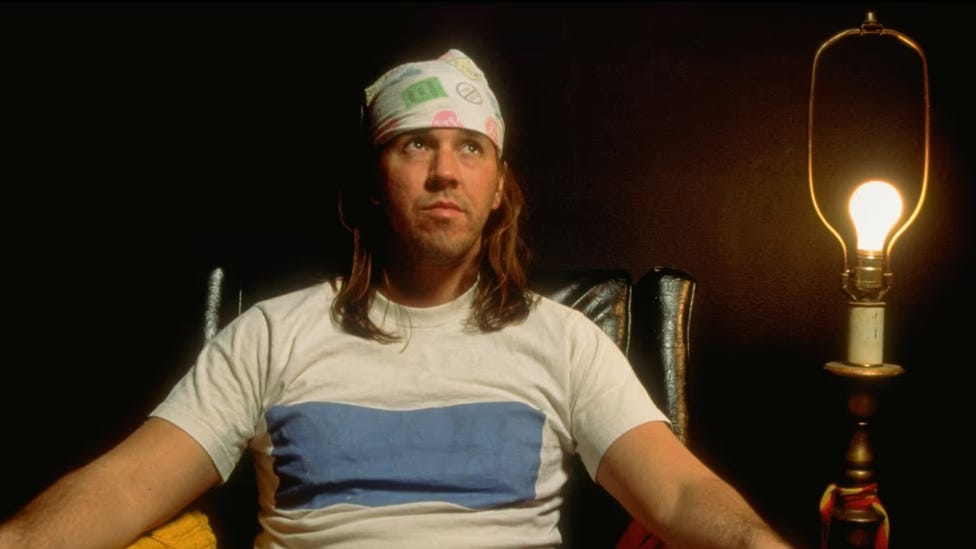
In recent years, Wallace has been held up as something of a prophet for how the advancement of technology would shape behavior. Some say he predicted “doomscrolling”, as his best-known book, Infinite Jest, is about a movie so addictive people watch it until they die. And in an interview depicted on film, he delivered a sensitive perception of the feeling of isolation and emptiness many of us are experiencing today:
“We’re gonna have to develop real machinery inside our guts to turn off pure unalloyed pleasure. Technology is gonna get better and better and it’s going to get easier and easier and more convenient to sit alone.”
He added that if this pleasure-feeding technology becomes the proverbial main staple of our diets:
“We’re gonna die in a very meaningful way.”
In most ways, I think AI is great and look forward to what it can do. But I am certain it’s going to test our less-than-optimal behaviors in ways we might not be ready for.
For creating an effective “machinery inside”, the first step may be to avoid the illusion that any tech is going to instantly make us who we wish to be — whether that’s wealthier, healthier or smarter.
Take it from the artist and writer Julia Cameron:
“It is impossible to get better and look good at the same time.”
Getting better takes work. It involves getting dirty, feeling miserable, failing repeatedly. All things you can’t prompt away. But when you come out of the other side, you’ll feel happier and more alive than before.
Research by Mihaly Csikszentmihalyi posited the theory of “flow” as a path to deep, lasting satisfaction: the best moments usually occur when a person’s body or mind is stretched to its limits in a voluntary effort to accomplish something difficult and worthwhile.
This is what writer Ryan Holiday was getting at when he wrote about how AI has reassured him of the value of old techniques:
This is why I do all my research on physical notecards. It is not fast, easy, or efficient. And that is the point. Writing things down by hand forces me to engage and struggle with the material for an extended period of time. It forces me to take my time. To go over things again and again. To be immersed. To be focused, patient, and disciplined. To come to understand things deeply.
Basically, Holiday is describing the cultivation of virutes and habits as a way to avoid becoming easily influenced by the temptions of AI.
Apply that to money and it means sticking with the tenets of finance: to spend less than you earn, to grow wealth gradually, and spend money on things that give you lasting meaning. It’s the practice of patience and discipline — the ability to think twice about the quick jump to riches.
Take it from Benjamin Franklin penned a list of resolutions that included:
To apply myself industriously to whatever business I take in hand, and not divert my mind from my business by any foolish project of growing suddenly rich; for industry and patience are the surest means of plenty.
Ultimately, when LLMs and AI bots spit out a statistical average of everyone else’s ideas, the right thing to do is to work on and cultivate what’s wholly yours — to exercise your own judgment. That is where creativity lies: defining what’s good, what’s worthy, what success means, what it means to be rich, what wealth means to you.
To build virtue and individual taste in order to think deeply may be the best step of all.
I’m reminded of Warren Buffett’s 2017 Berkshire Hathaway shareholder letter, where he suggsted one thing to do when the stock market is falling and people are losing their minds is to read this 19th-century Rudyard Kipling poem:
If you can keep your head when all about you are losing theirs ...
If you can wait and not be tired by waiting ...
If you can think – and not make thoughts your aim ...
If you can trust yourself when all men doubt you ...
Yours is the Earth and everything that’s in it.
The most radical thing to do is to be yourself — leaning into your lived experience, personality, preferences, convictions and passions. It’s a way of living meaningfully, rather than dying a meaningful death.
As the man on the penny encouraged:
“Whatever you are, be a good one.”
Do that and you’ll be able to stand above the noise, and if you listen intently enough, you might hear the enduring sounds of the past, the sound of a train whistle in the distance, followed by the laughter of children picking up flattened pennies.
Notes to my future self:
When we have to make a hard decision or act against our innate desires, we value money more.
Like money, when creation becomes instantaneous nothing feels earned, and therefore nothing feels worth longing for. A world where you can make anything at any time can easily become a world where nothing feels necessary.
The most radical thing to do is to be yourself — leaning into your lived experience, personality, preferences, convictions and passions. It’s a way of living meaningfully, rather than dying a meaningful death.
With gratitude,
J.S.
Excellent post!
I think Carl Sagan’s warning in his 1997 book, “The Demon-Haunted World,” feels like the societal analogue to your “friction disappearing” theme: when tech concentrates power and reduces the cost of consuming/ deciding/ thinking to near-zero, the public’s ability to question, discern, and set its own agenda atrophies. It’s the same danger you point to with AI—convenience that quietly trains us out of judgment.
“I have a foreboding of an America in my children's or grandchildren's time -- when the United States is a service and information economy; when nearly all the manufacturing industries have slipped away to other countries; when awesome technological powers are in the hands of a very few, and no one representing the public interest can even grasp the issues; when the people have lost the ability to set their own agendas or knowledgeably question those in authority; when, clutching our crystals and nervously consulting our horoscopes, our critical faculties in decline, unable to distinguish between what feels good and what's true, we slide, almost without noticing, back into superstition and darkness...
The dumbing down of American is most evident in the slow decay of substantive content in the enormously influential media, the 30 second sound bites (now down to 10 seconds or less), lowest common denominator programming, credulous presentations on pseudoscience and superstition, but especially a kind of celebration of ignorance.”
Not everyday you see a reference to Engadine Michigan. Let's go Eagles:)