
Friday Unwind 005
We can stop saying 'we' as we grow old

Ladies and gentlemen, it’s the weekend —
If you need something to occupy your mind, here are a few things I’ve been thinking about lately:
Can we stop saying “we”?
Guilty as charged. I’ve used the first person plural “we” many times. It’s the writing equivalent of “like”. You’ll find it used in blog posts, social media, traditional media, you name it. What makes my eyes roll are writers (maybe 90% of Substack) who make declarative statements — “we are social creatures” — without then providing any supporting information. (Again, guilty as charged.) It’s the writing style of fortune cookies and astrology — it sounds believeable, but is it really? Here’s a good argument for going we-free.
“If you are speaking for a very specific we, then say so. As Mark Twain is said to have said, ‘only presidents, editors, and people with tapeworms ought to have the right to use we.’”
What is consciousness?
This is a long, galaxy-brain, fascinating piece on that pesky invisible force known as consciousness.
“Many people believe that humans represent nature becoming conscious of itself, but what if nature is conscious of itself without our aid, and always has been? What if we are conscious of ourselves without our “selves,” at least if we think of the self as ineluctably bound to the body? What if consciousness is a fundamental property of the universe, like gravity or electromagnetic energy?”
The over / under on Nvidia
I’ve worked in finace for a good while, so I like to think I have a decent understanding of investing. Yet, over the past five years I’ve struggled to shake that “what the hell is going on” feeling. Fortunately, there are people like Aswath Damodaran to help make sense of it all, such as the pricing of Nvidia and trillion dollar market caps.
“No matter what your view, optimistic or pessimistic, you have to be open to changing your mind, as you are faced with data. Thus, if you have priced a company to deliver 20% growth in revenues over the next five years (to break even) and actual revenues growth comes in at 10%, you have to be willing to revisit your story, admit that you were wrong, and adapt.”
A good (really!) holiday gift guide
I dislike how the holidays have become more of an consumerist ritual. But I found myself reading every word of this gift guide from writer, entrepreneur and fellow MSU Spartan Robin Sloan. I mean, come on, look at these notebook covers:

Turning off AI
I’m not anti-AI, but it can annoy the hell out of me. Sometimes I just want a simpler user expereince. Like, perhaps, a blank page to write on. If that sounds like you, have no fear, Consumer Reports is here with this piece on how to disable some common AI tools.
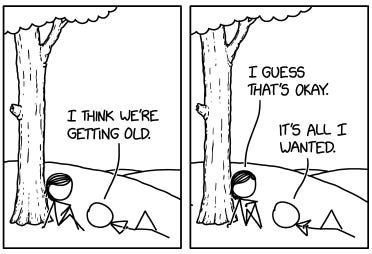
xkcd with all the feels
Fair warning, you might want to grab a tissue for this beautiful comic on life in Fifteen Years.
Two Cents: Maria Konnikova on Luck
You’re not lucky because more good things are actually happening; you’re lucky because you’re alert to them when they do.
We can’t control the variance. We can’t control what happens. But we can control our attention and how we choose to deploy it.